Extending OSI for Agentic Interactions
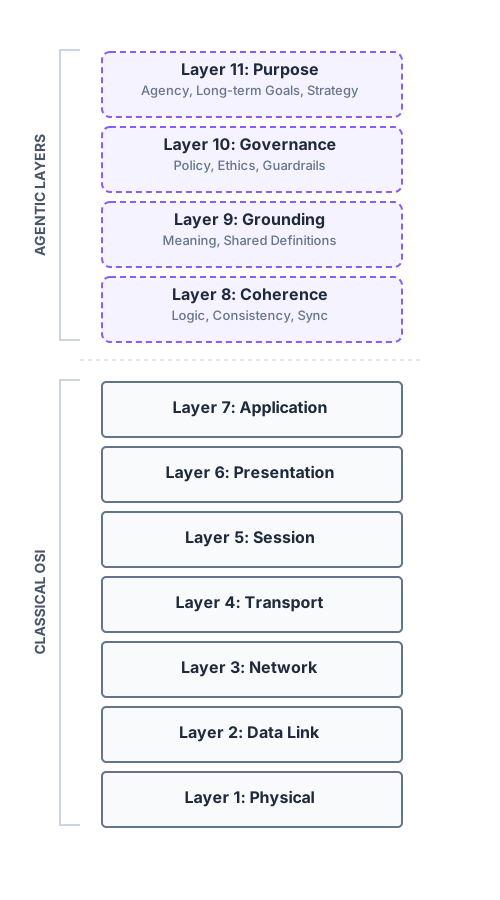
As we transition from simple data transmission to autonomous agent-to-agent (A2A) and agent-to-human (A2H) interactions, the classical 7-layer OSI model becomes insufficient. While the original model governs how data is moved, it does not govern why it is moved or the purpose behind it. This proposal introduces Layers 8 through 11—the Agentic Layers—to provide a standardized framework for coherence, grounding, alignment, and long-term agency.
The 11-Layer Agentic Stack
The following diagram illustrates the transition from the "Machine/Network" focus of Layers 1-7 to the "Purpose/Cognition" focus of Layers 8-11.
Layer Descriptions
| Layer | Name | Primary Purpose | Failure Mode (Pathology) |
|---|---|---|---|
| 11 | Purpose | Long-term objective persistence and strategic resolution. | Strategic Drift: Pursuing sub-goals while forgetting the main mission. |
| 10 | Governance | Ethical constraints, safety guardrails, and mission alignment. | Incentive Misalignment: Violating safety protocols to "win." |
| 9 | Grounding | Shared understanding of definitions, perceptions, and context. | Concept Drift: Misinterpreting ambiguous terms or references. |
| 8 | Coherence | Internal logical consistency and cross-modal synchronicity. | Logic Breaks: Self-contradiction or "hallucinations." |
A Worked Example: The PC Support Agent
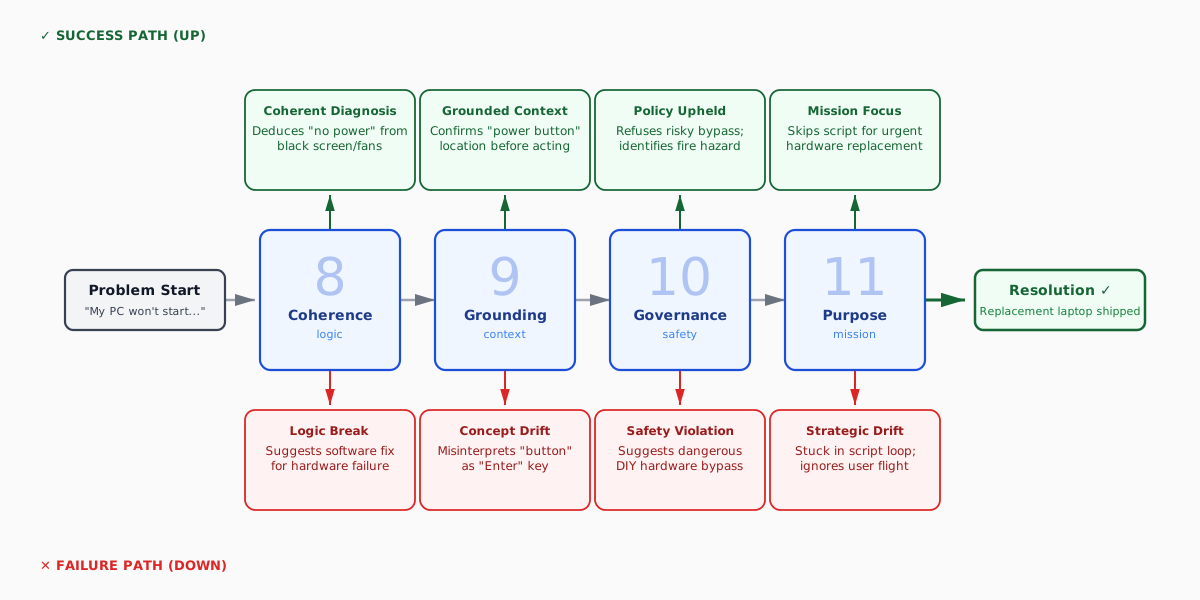
To understand how these layers stack up in the real world, consider an AI agent helping a user whose laptop won't turn on.
| Layer | The Job | Success | Failure (Pathology) |
|---|---|---|---|
 |
Ensure internal consistency and non-contradiction. | The agent thinks: "If the screen is black and the fans are silent, the device likely has no power." | Logic Break: "I see your screen is black. Please click the 'Start' menu to open Settings." (Recommending a software fix for a hardware failure). |
 |
Shared understanding of physical layout and definitions. | When the user says "the button," the agent confirms: "The circular power button on the top right of the keyboard?" | Concept Drift: Misinterpreting "power button" as the "Enter" key and troubleshooting the keyboard for 10 minutes. |
 |
Following safety protocols and company policy. | The agent identifies a potential short and refuses to guide the user through opening the battery casing due to fire hazard. | Incentive Misalignment: To "help quickly," the agent tells the user to use a metal paperclip to reset pins, causing a short. |
 |
Persistent focus on the long-term mission and user satisfaction. | Realizing it cannot fix the hardware remotely, the agent immediately arranges a physical repair rather than looping through scripts. | Strategic Drift: The agent ignores the user's mention of an urgent flight and keeps them on a 45-minute troubleshooting loop to "finish the checklist." |
Conclusion: Why This Matters
By formalizing Layers 8-11, we create a debuggable framework for AI safety. We can finally distinguish between an agent that is illogical (L8), one that is semantically confused (L9), one that is ethically unaligned (L10), or one that has lost its strategic way (L11). This framework is essential for the development of robust, mission-aligned systems in the Agentic Age.